Bra style names get confusing fast because brands do not use them in exactly the same way. Two bras in the same size can also feel completely different once you put them on.
This guide explains what the most common bra styles are built to do. If you do not know your size yet, start with the bra size calculator or how to measure bra size. It is much easier to judge a style when the size is close.
What do bra style names actually tell you?
A bra style name usually describes:
- the neckline shape
- the amount of cup coverage
- where the center front sits
- whether the bra is built for smoothness, lift, light support, or outfit compatibility
A plunge and a demi can both look low cut. A T-shirt bra and a full coverage bra can both feel more covered while solving different problems.
Style names are not fully standardized. b.tempt’d by Wacoal describes a balconette as an open-neckline bra with horizontal lift. ThirdLove makes a sharper distinction between balconette and demi coverage. Treat labels as clues, not promises.
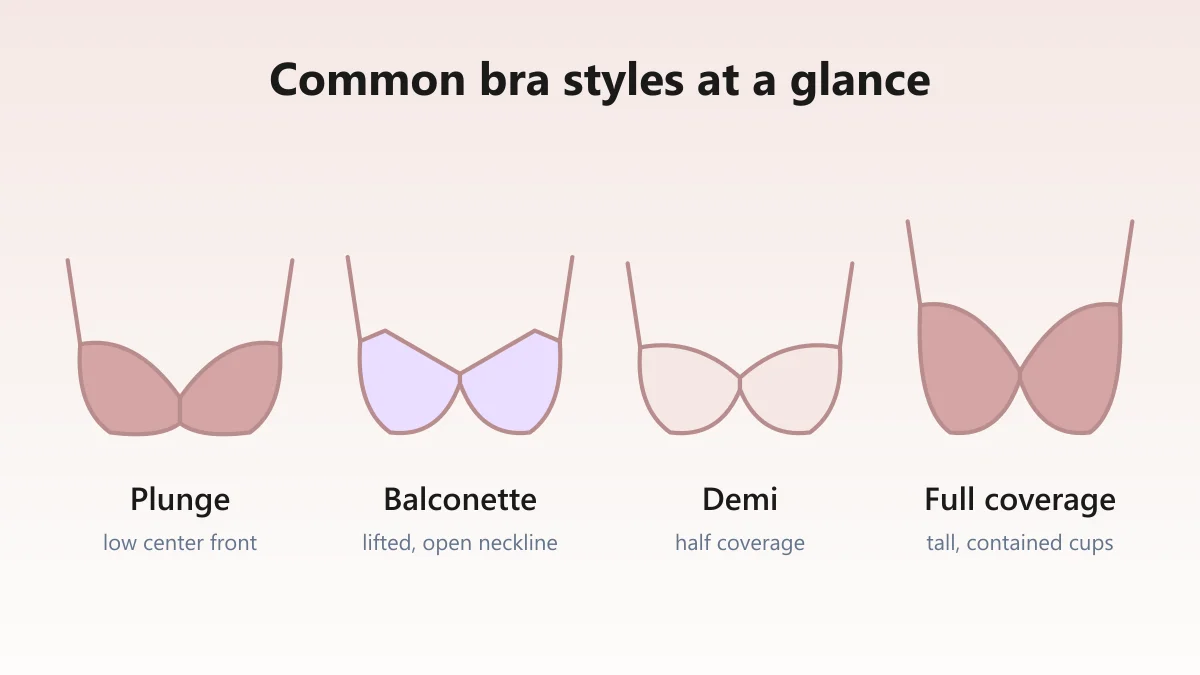
Quick bra style guide at a glance
| Style | Best known for | Often works well under |
|---|---|---|
| Plunge | Low center front and deep neckline | V-necks, wrap tops, low-cut dresses |
| Balconette | Open neckline with upward lift | Square necks, wide necklines, dressier tops |
| Demi | Moderate lift with less coverage | Lower necklines, everyday wear, shorter cup preference |
| T-shirt | Smooth molded look | Thin knits, fitted tops, basic tees |
| Full coverage | More containment and coverage | Workwear, button-downs, all-day coverage |
| Push-up | Extra lift from padding or cup design | Cleavage-focused looks |
| Bralette | Light structure or wire-free comfort | Casual outfits, lounging, light support days |
| Strapless | Support without visible straps | Off-shoulder and strapless outfits |
| Sports bra | Motion control during activity | Exercise and high-movement days |
What is a plunge bra?
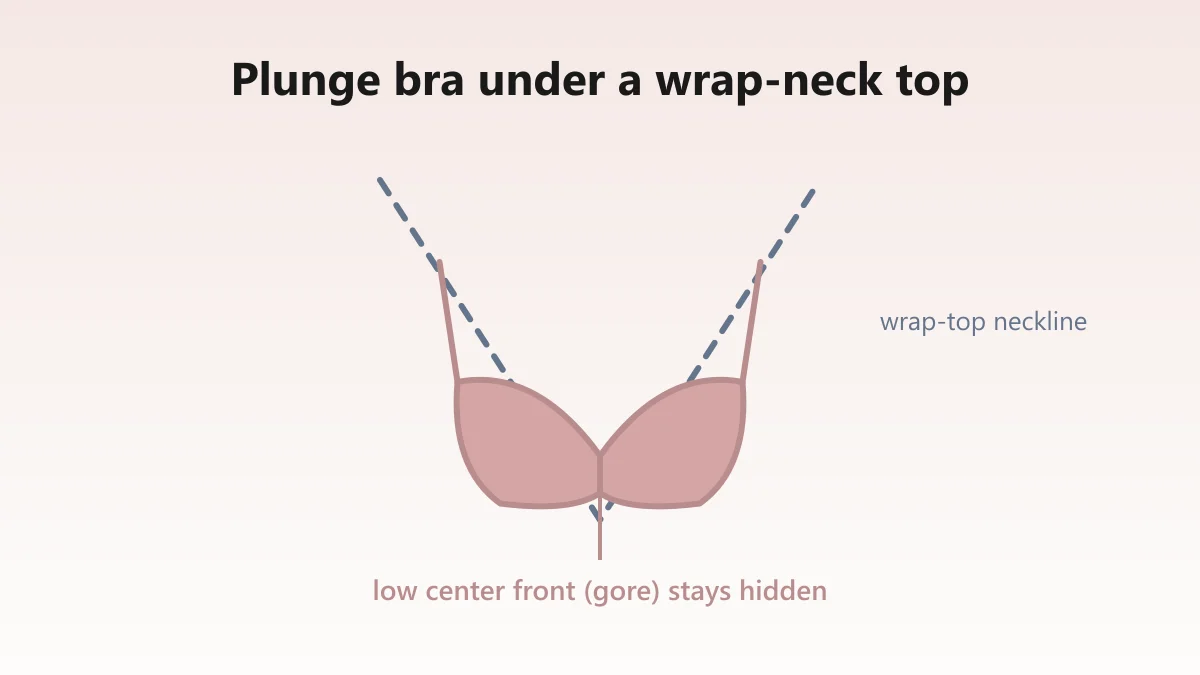
A plunge bra has a low center front, sometimes called the gore. That lower center works better under low necklines and wrap shapes.
Plunge bras are useful when a standard bra shows at the center of your shirt. b.tempt’d describes plunge bras as dipping low at the center front, and many brands use that lower center as the defining feature.
Plunge does not always mean heavy padding. Some plunge bras are lined. Some are push-up styles. Some are unlined. The lower center front and deeper neckline matter most.
Plunge bras can work well if:
- you wear V-necks often
- you want less bra show at the center front
- you prefer a lower gore because a high center feels intrusive
They do not fix every fit problem. If the cups cut in or the center still lifts away from your sternum, the issue may be size or shape rather than style. The signs of a bad bra fit can help you tell the difference.
What is a balconette bra?
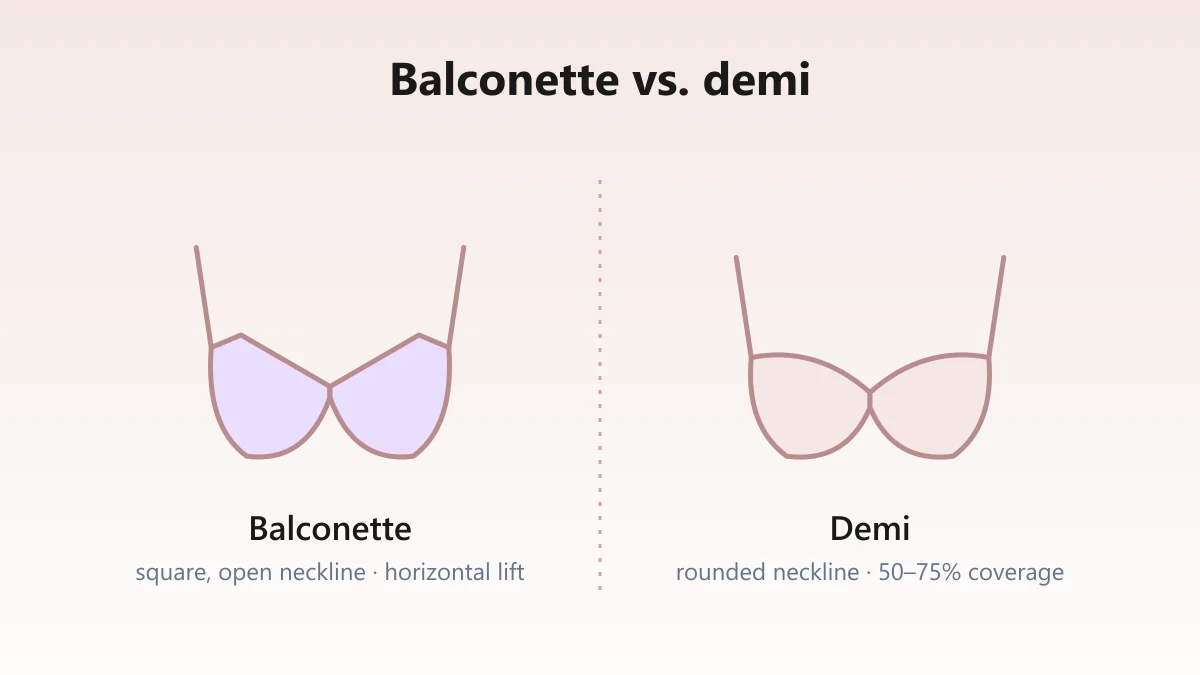
A balconette bra usually has an open neckline, cups that lift from below, and straps that sit wider apart than on many full coverage styles. The shape gives upward lift with a more horizontal or squared-off neckline.
That is where the “balcony” idea comes from. b.tempt’d describes balconettes as lifting horizontally. ThirdLove describes a square neckline with shorter cups.
Balconette bras often work well when:
- your top has a wider neckline
- you want lift without the look of a dramatic push-up
- you like a more open upper cup
Because the straps sit wider, this style can work beautifully under some necklines and feel annoying under others. If you already deal with slipping straps, test that before you commit.
What is a demi bra?
A demi bra is a lower-coverage style that usually covers about half to three-quarters of the breast, depending on the brand. The neckline is often lower and more open than a full coverage bra.
ThirdLove defines demi coverage as roughly 50% to 75% of the breast. In practice, that means less fabric at the top of the cup and an easier fit under lower necklines.
Demi bras often suit:
- shorter roots or breasts that do not need tall cups
- outfits where a high cup edge would show
- readers who want an everyday bra that feels less covering than full coverage
The overlap with balconette is real. Some brands separate the two clearly. Others use the words loosely. In store, focus on neckline shape, strap placement, and cup height instead of the label alone.
What about T-shirt, full coverage, push-up, and bralettes?
These styles are common too, and each solves a different wardrobe problem.
T-shirt bra
A T-shirt bra is built to look smooth under clothing, usually with molded or seamless cups. It can still be a demi, plunge, or full coverage shape. “T-shirt” tells you more about the finish than the neckline.
Full coverage bra
A full coverage bra gives more fabric and containment across the cup. It can help if you want more coverage at the top edge or less movement during long wear. If the cups are too tall for your shape, it can still gap.
Push-up bra
A push-up bra uses padding, cup shaping, or angled support to create more lift and cleavage. Some push-up bras are plunge styles. Others are demi styles. “Push-up” tells you what the bra is trying to do, not the exact neckline.
Bralette
A bralette is usually lighter, softer, and less structured than a traditional bra. Some are lounge styles. Others offer moderate support. It can be a good choice if comfort is your main goal, but it does not replace a better size or shape match.
How do you choose the right bra style for your outfit?
Start with the neckline and the level of support you need.
- Low V-neck or wrap top: plunge
- Square neck or open neckline: balconette
- Lower everyday neckline: demi
- Thin fitted tee: T-shirt bra
- More containment or workday coverage: full coverage
- Off-shoulder top: strapless or convertible
- Exercise: sports bra
Then check the fit on your body, not just the hanger. Breast shape, cup height, root width, and tissue distribution all change how a style feels. If upper cup gaping keeps happening, understanding your breast shape can help you stop blaming the wrong style.
Which bra style is best for everyday wear?
There is no single best everyday bra. The right one disappears under your clothes, stays comfortable for hours, and does not make you adjust it all day.
For many people, it is one of these:
- a T-shirt bra for smoothness
- a demi for lighter coverage
- a full coverage bra for containment
- a bralette or wire-free bra for softer support days
A small rotation usually works better than forcing one bra to handle every outfit. Many people do well with one smooth bra, one lower-cut bra, and one comfort-first option.
Why does a bra style still feel wrong even when the size seems right?
You can be in the right size and still hate the bra if:
- the cups are too tall for your shape
- the wires are too wide or too narrow
- the straps sit in the wrong place
- the neckline clashes with your outfit
- the fabric or cup structure does not match the level of support you want
That is why sister sizing is only part of the answer. If one bra style almost works but not quite, how sister sizes work can help before you jump to a very different size.
The simplest way to build a useful bra wardrobe
If you are not sure where to start, build around use cases instead of collecting random labels:
- One smooth everyday bra, often a T-shirt or demi shape.
- One outfit bra, often a plunge, balconette, or strapless style.
- One comfort bra, often a bralette or wire-free option.
Once you know which shapes work on your body, shopping gets easier. Start with a solid measurement. Use style names as clues. Judge each bra by comfort, support, and how it works with your clothes.